

Risk Assessment 101: What Every Employer Must Know
Creating a Strong Safety Culture – February Series (Part 2)
Why Risk Assessment Is the Foundation of Safety Culture in Canada
Across Canada, a strong safety culture begins with one core practice: effective risk assessment. While policies, training, and inspections are essential, they all depend on an employer’s ability to first identify and control workplace risks.
In every province and territory—and under federal jurisdiction—Canadian occupational health and safety legislation places a general duty on employers to take every reasonable precaution to protect workers. Risk assessment is the practical mechanism that fulfills this duty.
More than a compliance requirement, risk assessment is a leadership tool. Organizations that approach it proactively experience fewer injuries, stronger employee trust, better operational performance, and reduced legal exposure.
This guide explains Risk Assessment 101—what it is, why it matters in the Canadian regulatory landscape, and what every employer must know to build a resilient safety culture.
What Is a Workplace Risk Assessment?
A workplace risk assessment is a structured process used to identify hazards, evaluate the likelihood and severity of harm, and implement controls to eliminate or reduce risk before incidents occur.
This process applies to all Canadian workplaces, including construction sites, healthcare facilities, manufacturing plants, offices, transportation, retail, and remote work environments.
Why a Risk Assessment Is Important for Canadian Employers
Risk assessment is important because it helps employers prevent injuries, comply with occupational health and safety laws, protect workers, reduce costs, and build a proactive safety culture.
Under Canadian OHS frameworks:
- Employers are responsible for identifying hazards
- Supervisors must ensure controls are in place
- Workers have the right to know about hazards and participate in safety processes
Risk assessment operationalizes the Internal Responsibility System (IRS) that underpins Canadian safety law.
Risk Assessment 101: Quick Answers for Employers
What is a workplace risk assessment?
A workplace risk assessment is the process of identifying hazards, assessing risk levels, and implementing controls to prevent harm to workers and others.
Who is responsible for conducting risk assessments in Canada?
Employers are legally responsible, but effective risk assessments involve supervisors, joint health and safety committees, health and safety representatives, and workers.
How often should risk assessments be reviewed?
Risk assessments should be reviewed regularly and whenever work processes change, new equipment is introduced, or incidents or near misses occur.
Are risk assessments required by law in Canada?
Yes. While terminology varies by jurisdiction, all Canadian OHS laws require employers to identify and control workplace hazards.
How to Conduct a Risk Assessment: Step-by-Step
Step 1: Identify Workplace Hazards
A hazard is anything with the potential to cause harm. Common workplace hazards include:
- Physical hazards (machinery, noise, slips, falls)
- Chemical hazards (dusts, fumes, solvents)
- Biological hazards (viruses, bacteria, bodily fluids)
- Ergonomic hazards (repetitive motion, awkward postures)
- Psychosocial hazards (stress, fatigue, harassment, workload)
Effective hazard identification methods include:
- Workplace inspections
- Job safety analyses (JSAs)
- Incident and near-miss reviews
- Employee consultation
Canadian regulators consistently emphasize worker participation—those doing the job often see risks first.
Step 2: Determine Who May Be Harmed and How
Risk is not evenly distributed. Employers must consider:
- New or young workers
- Temporary or contract workers
- Maintenance and cleaning staff
- Lone or remote workers
- Workers with medical limitations
Understanding who is exposed supports equitable and legally defensible risk controls.
Step 3: Evaluate the Level of Risk
Risk evaluation considers:
- Likelihood of an incident occurring
- Severity of potential injury or illness
Many Canadian organizations use risk matrices to prioritize hazards. The objective is not to eliminate all risk, but to reduce risk to a level that is as low as reasonably practicable.
Step 4: Apply Controls Using the Hierarchy of Controls
What Is the Hierarchy of Controls?
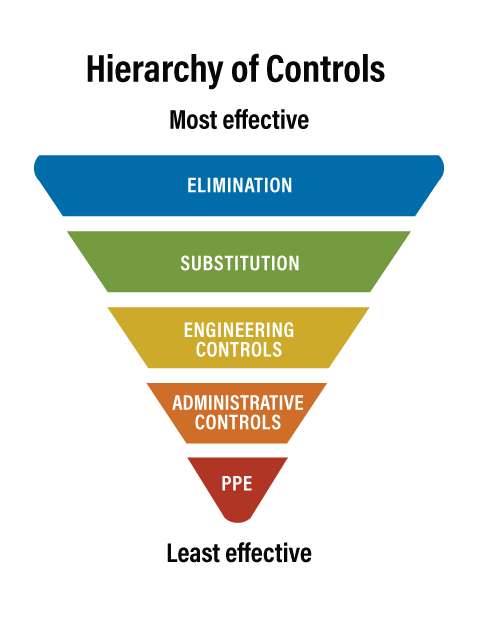
The hierarchy of controls ranks risk control methods from most to least effective:
- Elimination – Remove the hazard entirely
- Substitution – Replace with a safer alternative
- Engineering controls – Isolate people from the hazard
- Administrative controls – Procedures, training, scheduling
- Personal protective equipment (PPE) – Last line of defense
Canadian regulators consistently expect employers to prioritize higher-level controls before relying on PPE.
Step 5: Review, Document, and Improve
Risk assessments are living documents and must be:
- Documented and accessible
- Reviewed at regular intervals
- Updated after incidents, near misses, or changes
- Integrated into daily operations
Continuous improvement is a defining characteristic of strong safety cultures.
Common Risk Assessment Mistakes Employers Make
Despite good intentions, organizations often:
- Treat risk assessments as paperwork exercises
- Use generic templates without customization
- Fail to involve workers or committees
- Neglect psychosocial hazards
- Do not update assessments after changes
In Canada, enforcement actions frequently follow predictable, preventable gaps.
How Risk Assessment Strengthens Safety Culture
When done effectively, risk assessment:
- Reinforces shared responsibility under the IRS
- Encourages employee engagement and reporting
- Shifts safety from reactive to proactive
- Reduces injuries, downtime, and compensation costs
- Builds trust between leadership and workers
Safety culture is demonstrated through daily decisions, not written policies.
Risk Assessment as a Leadership Responsibility
In high-performing Canadian organizations, leaders do not delegate safety thinking—they model it.
Thought-leading employers:
- Integrate risk discussions into planning and operations
- Invest in prevention rather than post-incident response
- Empower supervisors and workers to act on risk
- Treat safety as a core business value
Risk assessment is where compliance, ethics, and leadership converge.
Frequently Asked Questions About Risk Assessment
What is the difference between a hazard and a risk?
A hazard is something that can cause harm, while risk is the likelihood and severity of that harm occurring.
Can risk assessments be generic across multiple sites?
No. Canadian regulators expect risk assessments to reflect site-specific tasks, conditions, and workers.
Do small businesses in Canada need risk assessments?
Yes. All employers, regardless of size, are responsible for identifying and managing workplace hazards.
What happens if an employer fails to conduct a risk assessment?
Consequences may include injuries, regulatory orders, fines, prosecutions, reputational damage, and operational disruption
Key Takeaways for Canadian Employers
- Risk assessment is the foundation of a strong safety culture
- It is a legal obligation across all Canadian jurisdictions
- Effective risk assessments involve workers and supervisors
- The hierarchy of controls must guide risk reduction
- Continuous review is essential for compliance and prevention
Looking Ahead in the Safety Culture Series
This blog establishes the foundation. In the next installment of “Creating a Strong Safety Culture,” we will explore how to engage workers in safety ownership via training —turning risk assessments into meaningful action across Canadian workplaces.